

WOLF CREEK GRIST MILL
Historic Park & Museum
History of Wolf Creek / Pine Run Grist Mill
Original Construction & Location
In 1818, War of 1812 veteran Isaac Wolf came to Ashland County and settled on 160 acres in the northwest quarter of section 25 of Green Township. He chose a site over a mile from any other dwelling and constructed a log cabin from local timber. He married Nancy Small and had eight children.
In 1831 Isaac Wolf leased out land to Isaac Meanor, who built a Grist Mill on the property that same year. The mill was powered by the water flow from nine different hillside springs, which makes it different from most mills, which are traditionally powered by taking advantage of the elevation change along the course of a river. Meanor named it Wolf's Mill, in honor of the landowner.
Eventually, years later Isaac Wolf's grandson, also named Isaac Wolf, purchased the mill with his brother and operated it successfully for many years.
Oliver Evan's Design
Wolf's Mill was built based on the Oliver Evans design for an "automatic flour mill", laid out in Evans' 1795 book The Young Millwright and Millers Guide, which was a detailed engineering explanation of Evans' patented milling system. This system mechanized many of the tasks that had previously been done by manual labor and evolved the milling process from batch production to continuous flow production. This was accomplished with the use of various bucket elevators, chutes, hoppers, and milling machines designed for material to continuously flow through. His patented system was considered cutting-edge manufacturing technology at the time.
Prior to the publication of the book, the Evans system was issued the 3rd ever US Patent in 1790, and was signed by the President at the time, George Washington. Washington was so impressed by the technology, he paid Evan's licensing fee of $50 per set of millstones, and had his own gristmill at Mount Vernon, in Virginia, converted to the Evans system, starting in 1791. Learn more here:
https://www.mountvernon.org/the-estate-gardens/gristmill/oliver-evans-systems
How the Mill Works
In general, the flow of raw grain (either corn or wheat) through the mill coming out as finished products looked something like this: 1) Raw grain is brought to the mill by a farmer, which is then weighed in by the miller, and dumped into a receiving hopper. 2) The grain is then transported to an upper floor of the mill by a bucket elevator, and run through a grain cleaning machine, or fanning mill, which used air and screens to separate any foreign material from the grain to be ground. 3) From there, the cleaned grain went through a chute into a bin above the grinding floor, where it would be fed into the millstone via another chute with a wooden gate to control flow. 4) At this point, the grain would pass through the millstones, being ground into different size pieces, from larger pieces of husk and bran, down to fine dust, or flour. 5) This mixture of all the parts of the ground grain, or grist, would then pass through another chute to an elevator, and be transported back to the top level of the mill to the hopper boy, which is an automatic rake system that spread the raw ground grain onto a cooling floor, and gradually moved it toward another chute as it naturally cooled. This was required to dissipate the friction heat created during the grinding process. 6) After cooling, the mixture would pass through another chute to a bolter, which is a large rotating sifter, with the grist passing through a horizontal rotating cylinder, which is covered with progressively coarser screens and fabrics, allowing the different particle sizes to fall through as the material works it way through the machine. The finest material falls through first, and then progressively larger and larger particles, which separated the raw grist into the various grades of flour or cornmeal, grits, bran, animal feeds, etc. This process was generally repeated in several steps to fully separate the grist into its final, finished products. 7) The finished products coming out of the bolters would then be stored in separate bins, ready for packaging and sale, or to be returned to the farmer, less the miller's toll.
For wheat flour, the finished products were generally superfine white flour, fine flour, middlings, and shipstuff, which was generally animal feed. For corn, it was corn flour, bolted cornmeal, unbolted cornmeal, and grits.
Wolf Creek Mill has a 16' overshot water wheel, powering 2 sets of 42" French buhrstones. The stones at the mill were studied by geologists from the Cleveland Museum of Natural History, and confirmed to have been quarried from a specific quarry outside of Paris, France, based on the inclusion of specific fossilized microorganisms. The stones were transported to the U.S. in pieces as ballast in ships, and were then reassembled in port, and shipped to the mill site. These French buhrstones were sought after over locally available stone due to their hardness, texture, and most importantly, color. The French stones were white, which disguised any stone particles in the white flour, making the flour more appealing to customers.
This is a simplified diagram of how an Evans mill is designed and closely reflects how Wolf Creek Mill is set up:


If you're interested in learning more about the ancient history of milling, check out these resources:
https://en.wikipedia.org/wiki/Quern-stone
https://en.wikipedia.org/wiki/Watermill
https://grainmaker.com/a-brief-history-of-milling/
https://en.wikipedia.org/wiki/Gristmill
Kettering Connection
In the 1880s and 1890s the mill was frequented by a young Charles Kettering, who on his way home from the local one-room school he attended would stop and talk with the millers. Later in his life, Kettering said that it was at Wolf's Mill where his real education came from. It was here he learned about engineering, physics, and more. Learn more about Charles Kettering's incredible accomplishments here: https://en.wikipedia.org/wiki/Charles_F._Kettering
The 1897 maps below show the original location of the mill on Isaac Wolf's property along what is now SR60 north of Loudonville, as well as the location of the Kettering farm next door.

Technological Advances & Decline of Water Power
With various advances in transportation and power sources, many traditional water-powered community grist mills were in decline by the late 1890s and early 1900s.
Throughout the late 1800s, steam power began to replace water power, and in some limited areas near cities, industrial electrical power became available. These newer, more efficient, more reliable power sources allowed for larger merchant mills to be built in locations near cities and transportation hubs, reducing the need for mills located on rivers. Additionally, improvements in roads and rail transportation enabled more efficient movement of grain to these larger, more centralized mills, putting further pressure on the smaller, dispersed water-powered mills, making them less economically viable.
Also during this period, individual farmers started to have access to mechanical power sources directly on the farm, first with steam engines in the 1880s, then hit and miss engines in the 1890s-1910s, and eventually gasoline powered tractors in the 1920s. This gave farmers the ability to power various implements, such as thrashing machines and small, "portable" mills that could be run off a traction belt. This further reduced farmers' reliance on the traditional water powered mills that had been the only source of mechanical power other than draft livestock since ancient times. An early example of this type of belt-driven portable mill, likely a Bradford from the 1870's-1880's, is on display in our museum, with later designs such as the Meadows Mill becoming popular later.


In an effort to remain economically competitive during this period, many traditional mills were updated from stone to roller mills, or water wheels to turbines. This is why both the original buhrstones and newer steel roller mills are installed at Wolf Creek Mill, as the mill would have adopted new technology as it became available, just like in any modern industrial application.
Also during this time rural electrification was on the horizon, really taking off in the late 1920s and 1930s, pushing water power further into obsolescence.
Flood of 1913
In March of 1913, up to 9" of rain fell on already saturated ground in an area from southern Illinois to northwest Pennsylvania, resulting in a devastating flood across large areas of Ohio and surrounding states. The resulting damage led to hundreds of deaths, and huge amounts of property damage..
Mills were one of the hardest hit industries during the flood, owing to their natural location on river banks. With all of the larger economic and technological factors already putting pressure on the business model of the traditional mills, it simply wasn’t economically feasible for most mills to rebuild and reopen after the flood, and Wolf’s Mill was no exception. After 82 years of operation, the mill was shuttered.
To give some idea how dramatic the decline was around this time, consider that in 1840, there were 1,861 water powered mills in Ohio. By 1870, that number had declined to 1,181, but by 1922 a few years after the flood, there were only 94 water-powered mills remaining.
As a side note, the Flood of 1913 also had several other significant impacts on Ohio, including the end of the canal era, due to the same damage and technological obsolescence suffered by water powered mills. The flood also led to the establishment of the Muskingum Watershed District, and other flood control districts like it, resulting in the construction of numerous flood control dams across Ohio. Today, the resulting lakes are prized for recreation, including Pleasant Hill Lake, Charles Mill Lake, and many others.


Attempt at New Uses & Abandonment
Eventually, in 1925, the 4th generation of the Wolf family, Isaac's son William Wolf, took over the mill. William renovated the first floor and reopened it as a "resort," serving chicken dinners on the weekends. The resort was short lived, though, because according to Isaac and Alice's granddaughter, Virginia Wolf, people grew tired of always eating chicken.
After the resort failed, and with the Great Depression starting in 1929, the mill was closed and stood abandoned. Even after only a few years, it quickly deteriorated to the point that a traveler in 1931 noted its poor condition; "in a state of collapse, the [water] wheel itself leans over against the mill, no more to make a turn till the crack of doom."
Not many specifics are known about what the mill building was used for during the next 40 or so years, or if it just sat vacant, but either way, it continued to fall further into disrepair over the decades.
Relocation by Ed Pennell & Purchase by Ohio State Parks
In 1972, Ed Pennell purchased the building after it was slated for demolition to make way for the straightening of State Route 60. He disassembled the structure, piece by piece, and moved it south of Loudonville along Route 3, to its current location. He renamed it Pine Run Mill, after the creek it sits beside, and reopened it in 1975. Pennell operated the Mill as a tourist attraction and ice cream parlor until the mid-1980s.
After the ice cream parlor ceased operation, the property was eventually purchased by the Ohio State Park system in 1990, due to being adjacent to Mohican State Park. There were initally plans to restore the building, and possibly use it as park offices, but due to budget cutbacks, the plans were abandoned and the building once again began to fall into disrepair.
Friends of Wolf Creek / Pine Run Grist Mill, Inc.
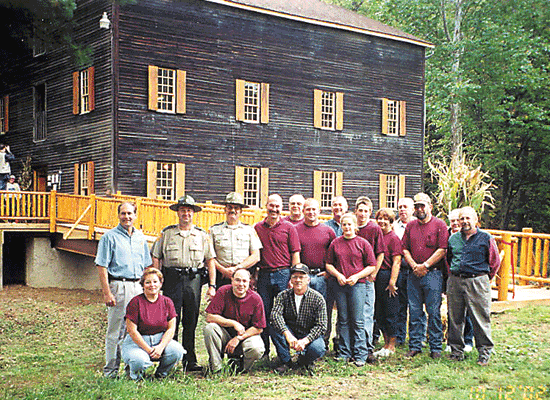
In 1998, a grassroots effort to restore the mill was started by Mark Smith, who stumbled across the overgrown, boarded up building during a family bike ride while camping at Mohican.
Mark initially just wanted permission from the State to replace the roof on the building, to keep it from deteriorating further. It took some persistent and "gentle" persuasion, but eventually the State agreed to allow him to replace the roof. With a few modest donations and some donated roof shingles, the roof project was completed and the building stabilized.


From there, things snowballed quickly, with initial projects including replacement of all the windows in the building, building and installing wooden shutters for all windows, structural stabilization and replacement of the 1st floor floor system, installation of an electrical service, and the formal formation of Friends of Wolf Creek / Pine Run Grist Mill, Inc., a 501c3 non-profit.
This is where the current misnomer of the mill originated; the original name of the mill was "Wolf's Mill" and the name given to it after the relocation was "Pine Run Grist Mill". At the time the non-profit was established, the volunteers still had limited information about the history of the mill, and as such, mistakenly assumed that the original "Wolf" name had come from the original creek it sat on. However, this was incorrect, as the mill didn't originally sit directly on a creek, and it was named after it's owner, not the waterway. As time went on, and the details of the mil's history were clarified, the true original name was rediscovered, but by then, "Wolf Creek / Pine Run Grist Mill" had become the commonly used name of the building, and still what it's called today.
In 2001, the group had the opportunity to salvage a large amount of pristine mill machinery from the partially collapsed Rummel Mill, in Butler, Ohio. Prior to its partial collapse, Rummel mill looked like someone walked out the door to go to lunch in the early 1900's and just never came back. It was the most intact and original mill any of our volunteers had ever seen. Its collapse was a tragedy, but it's fortunate that the equipment was able to be salvaged and preserved. See photos and history of Rummel Mill here: https://www.historic-structures.com/oh/butler/rummell-mill/
In 2002, the volunteer group completed the replacement of the pedestrian bridge across Pine Run Creek, allowing safe access to the building, and a bridge strong enough to allow the Rummel Mill equipment to be rolled across and put on display.
From there, the group of dedicated volunteers continued to restore the mill machinery, water wheel, and drivetrain, including installation of a cistern and pump system to replace the hillside spring that fed the mill in its original location.
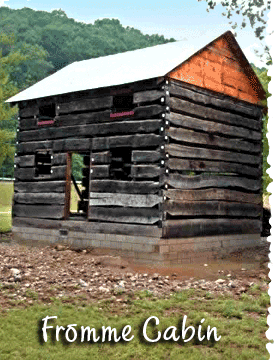
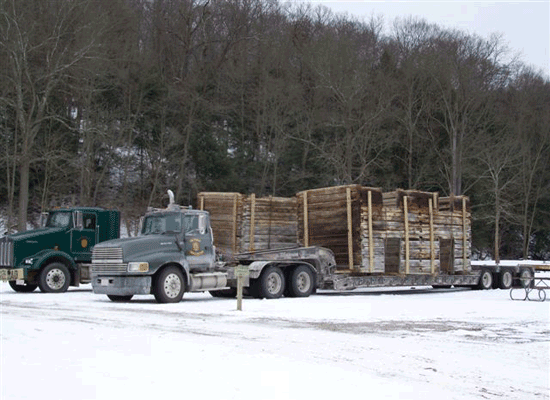
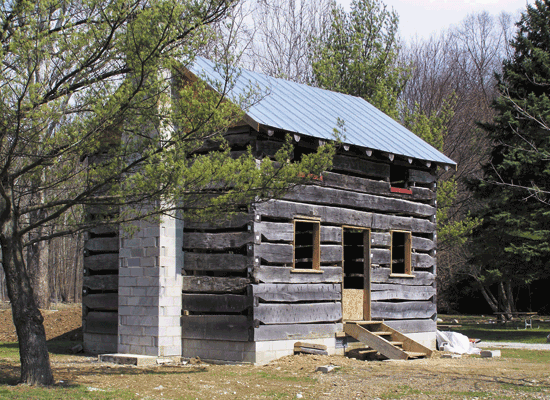
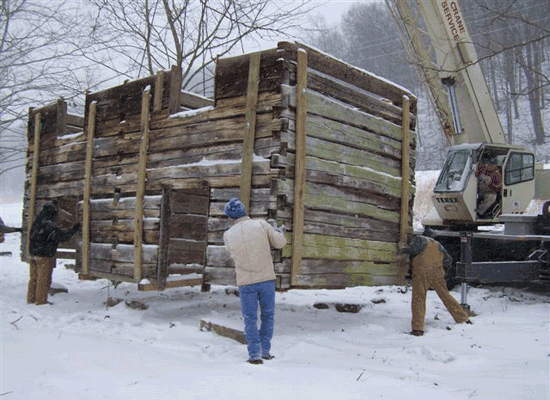
Also, over time, multiple individuals approached the group about saving deteriorating log cabins at various locations, first the Fromme Cabin in 2002, which is now our visitor center. In 2008-2009, a series of log buildings from Paint Creek State Park were moved in and restored, including a log corn crib, log smoke house, log chicken coop, and even a log outhouse. The Schenk & Hooven cabins were dismantled and moved in after that, with the usable logs of each being combined to build the homestead cabin at the center of the Paint Creek buildings.


In 2013, the group was able to acquire the adjacent property to the south of the Mill grounds, enabling the creation of a seasonal work camper program, which increased the operating hours of the mill museum. This property also became the home of the group's fundraising events (Winefest & Oktoberfest), which provide the majority of the funds to continue the restoration, maintenance, and operation of the museum.
The Friends of Wolf Creek / Pine Run Grist Mill continue partner with Ohio State Parks to maintain and operate the mill and grounds as a museum, and are very close to completing restoration of the Schneck / Hooven Cabin.
- Portions of the above history are courtesy of The Cleo Redd Fisher Museum in Loudonville.
If you have any additional historic details to share about the mill or cabins, please send info to chris@wolfcreekmill.org